
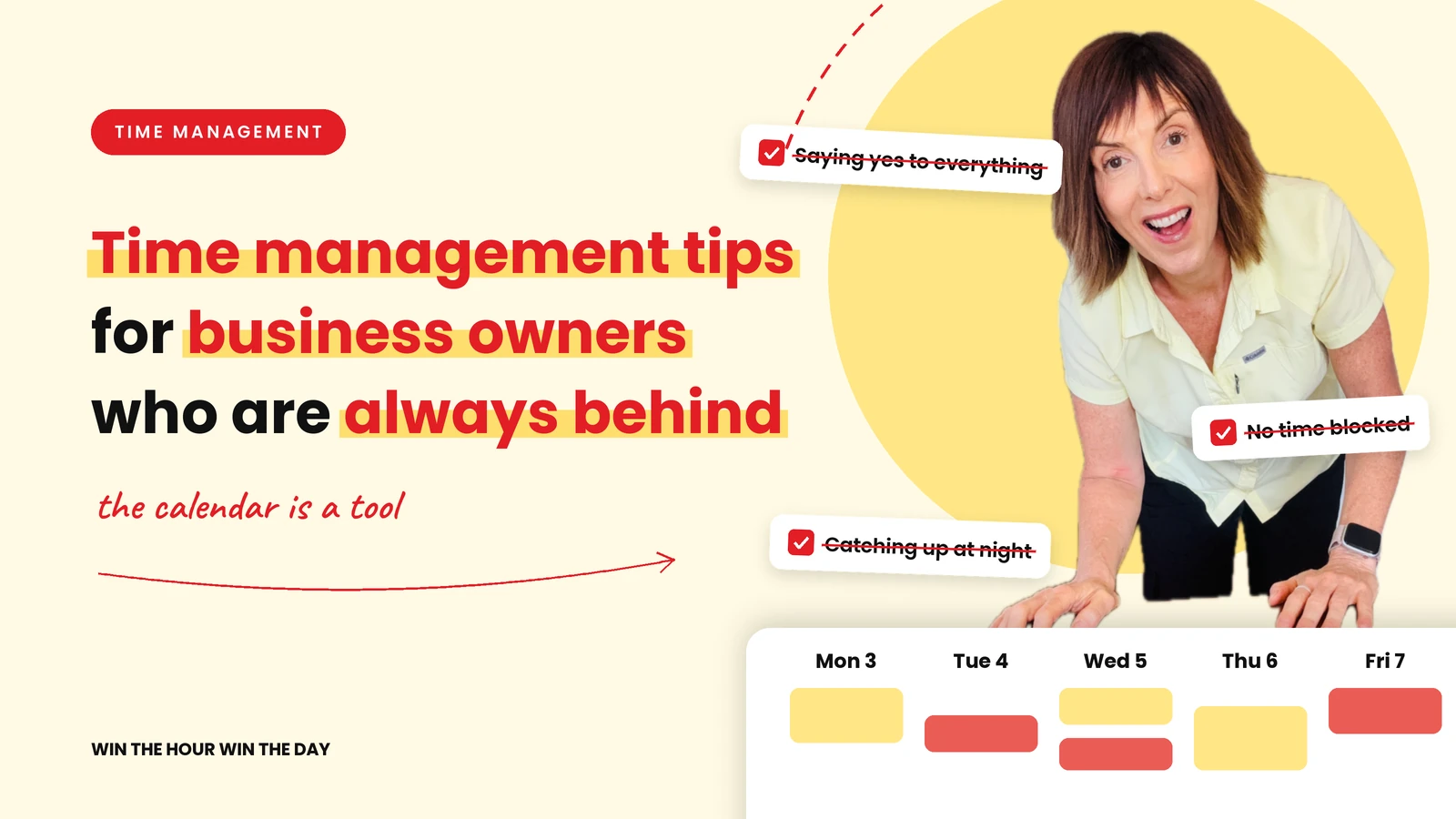
What are the best time management tips for business owners who are always behind? Sort your real work from the pre-work and post-work, plan your day in hours on your calendar, and move every repeat task into a Super Toolkit so a trained virtual assistant can run it without you.
You tell yourself you'll catch up this weekend. Or once you get past this next thing.
The next thing never ends.
I know that line well. I used to start work 2 hours before my husband got up…
and I still ended most days behind.
Nobody handed me a better way to run my days. I figured it out the hard way. These are the tips that changed my days, and the days of the founders we work with.

What are the best time management tips for business owners?
The best time management tips for business owners change where the work lives, so less of your day has to run through you.
You can't add hours to a day. Getting up earlier to get ahead only moves the problem to the morning.
What you can change is how much of the day needs you.
Here are the 6 tips that made the biggest difference for us.
#1 Find your real work
Your real work is the reason you started your business, and almost everything around it is pre-work and post-work.
Your expertise is the real work. The talk, the client session, the book, the advice only you can give.
Everything before it is pre-work. The scheduling, the research, the prep. Everything after it is post-work. The follow-ups, the invoices, the uploads.
Most founders spend the biggest part of their week on pre-work and post-work…
and the real work slides into the evening.
It shows up in your income too. You land new business, get buried in delivery and stop marketing. Then the pipeline empties. That's the income roller coaster.
- ✓What tasks eat up my time but don't move the business forward?
- ✓Which of these do I do every single week?
- ✓Which of them really need me?
- ✓Which could someone else run if the steps were written down?
Anything on that list that isn't your real work is ready to move.
#2 Plan your day in hours, on your calendar
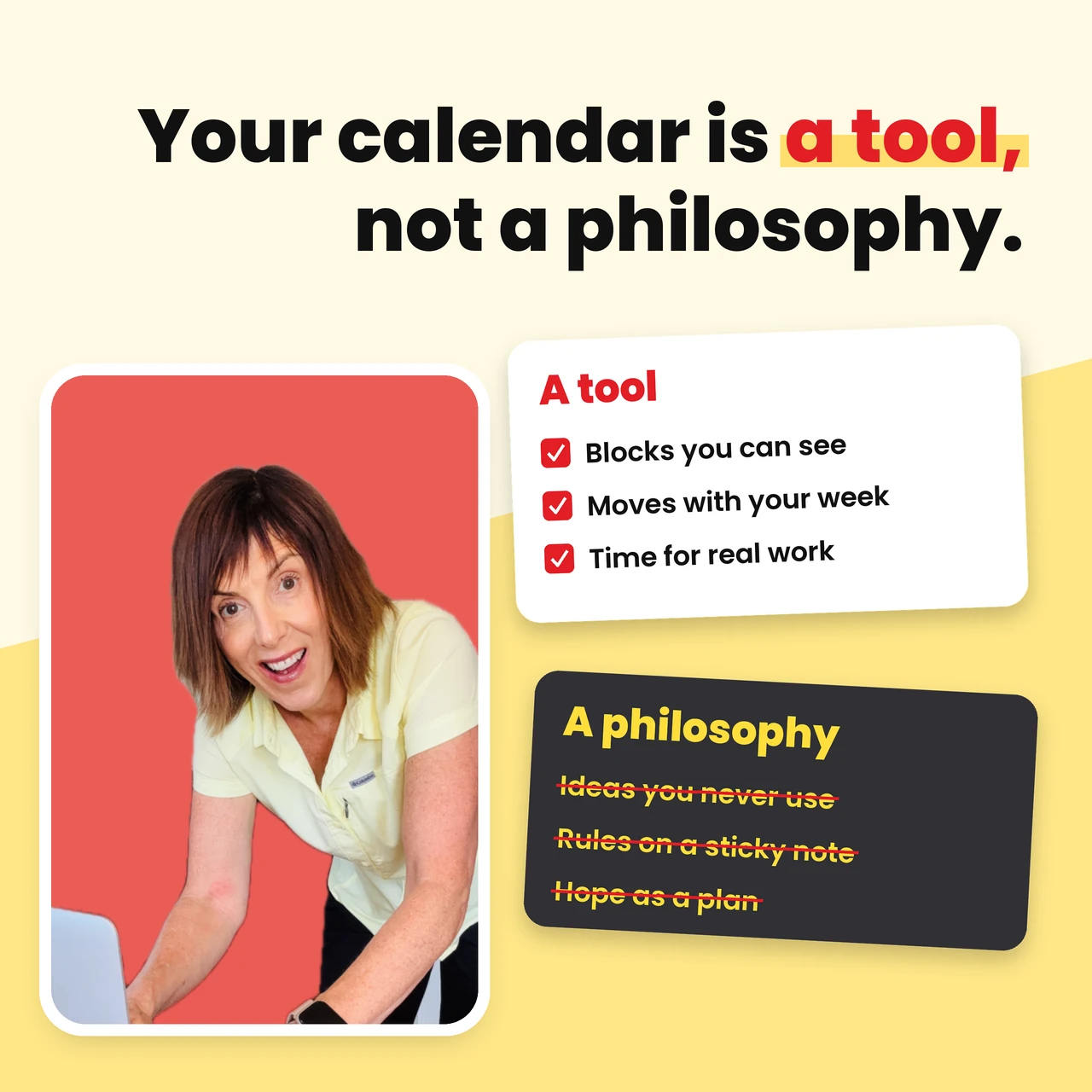
Win The Hour means every task gets a block of time on your calendar, because your calendar is a tool, not a philosophy.
When you plan in hours, you see your day for what it really is.
8 hours of plans won't fit into 5 open hours. With a plan in hours, you find that out at 8 AM instead of 8 PM.
You also learn how long your work really takes. That matters later, when you hand the work to someone else and need to know what a fair day looks like.
Try it for 1 day
Put every task on your calendar in hours, admin included. At the end of the day, look at what fit and what didn't. That gap is where your evenings go.
For more ways to win back your week, read these time-saving tips for your business.
#3 Do your best work when your energy is highest
Manage your energy as well as your hours, and give your sharpest time to the work that makes you money.
Some work makes you money directly. Do that work when you feel most awake and focused.
Everything else can wait, or go to someone else.
Rest counts as part of the plan. A tired founder makes slow decisions…
and slow decisions cost hours.
If you've ever caught yourself thinking "I'm running out of me," this is the tip to start with.
#4 Watch for the 3 D’s of a messy schedule
A messy schedule costs you in 3 ways, damaged overhead, delayed income and diminished opportunities.
I first talked about the 3 D's in a podcast episode with Connie Whitman. They never show up on a bill…
so here they are as a receipt.
Charged to your business
Keep your daily plan clean and focused, and this receipt gets a lot shorter.
#5 Don’t delegate, replicate
When the steps for a task live in a Super Toolkit, anyone on your team can repeat the work without waiting on you.
"It's quicker if I do it myself." That's true the first time. By the 50th time, it's the slowest choice you have.
Handing work off without a setup is a lateral move. If the steps only live in your head, the work still comes back through you.
When you're the only person who knows how a task gets done, your team waits. That's how founders become the bottleneck.
→Related read, How to Stop Being the Bottleneck in Your Business
Your brain is for creating ideas and not storing them.
Kris Ward
A Super Toolkit keeps the steps and links for a task together, so anyone can repeat the work the same way every time.
Super Toolkits
The steps and links for each task, together, so the work can be replicated without you.
Scrum
A short daily Scrum where your team shares what they're working on and where they're stuck. Anything longer can often be a short Loom video.
Scrum keeps the work moving between you and your team. Here's how Scrum works in a small business.
#6 Bring in a virtual assistant sooner than you think
The best time to bring in a virtual assistant is the day you start your business, and the next best time is today.
Most founders wait until they're buried. By then there's no time to hand anything off well.
So they hire someone, stay too vague and take the work back. "I tried a VA. It didn't work."
Most of the time, the fix is in the setup around the person.
The best time saving tip is to eliminate work.
Kris Ward
Founder, Win The Hour Win The Day
That's why we set up the work first. Then we find, hire and onboard a full-time virtual assistant we train to lead.
Christine went from crazy hours to 9 days a month. I went from 16-hour days down to 6.
Your business should support your life, not consume it.

Always behind, and not sure why?
Take the 5 Minute Capacity Check and see what's ready to come off your plate.
TAKE THE 5 MINUTE CAPACITY CHECK
Key Takeaways
- ✓Your real work is your expertise. Everything around it is pre-work and post-work.
- ✓Plan your day in hours. Your calendar is a tool, not a philosophy.
- ✓Give your sharpest hours to the work that makes you money.
- ✓Watch for the 3 D's, damaged overhead, delayed income and diminished opportunities.
- ✓Don't delegate, replicate. Put the steps for every repeat task in a Super Toolkit.
- ✓Bring in a virtual assistant sooner, with a setup they can lead in.
Frequently asked questions
What are the best time management tips for business owners?
Separate your real work from pre-work and post-work, plan your day in hours on your calendar and give your sharpest hours to the work that makes you money. Then put repeat tasks in Super Toolkits so a trained virtual assistant can run them.
What is pre-work and post-work?
Your real work is your expertise, the reason you started the business. Pre-work is everything that gets you ready for it, like scheduling and prep. Post-work is everything after it, like follow-ups and invoices. Both can move to someone else.
How does Win The Hour work?
Every task gets a block of time on your calendar. You see what fits in your day, how long your work really takes and what's ready to hand off. The calendar is a tool, not a philosophy.
Why do I keep falling behind when I already work long days?
Long days leave the setup the same. If the steps for your work only live in your head, it all runs through you. A Super Toolkit, a short daily Scrum and a virtual assistant trained to lead take that weight off your plate.
TAKE THE 5 MINUTE CAPACITY CHECK
Hear how Janene Liston is doing less and getting more bookings.