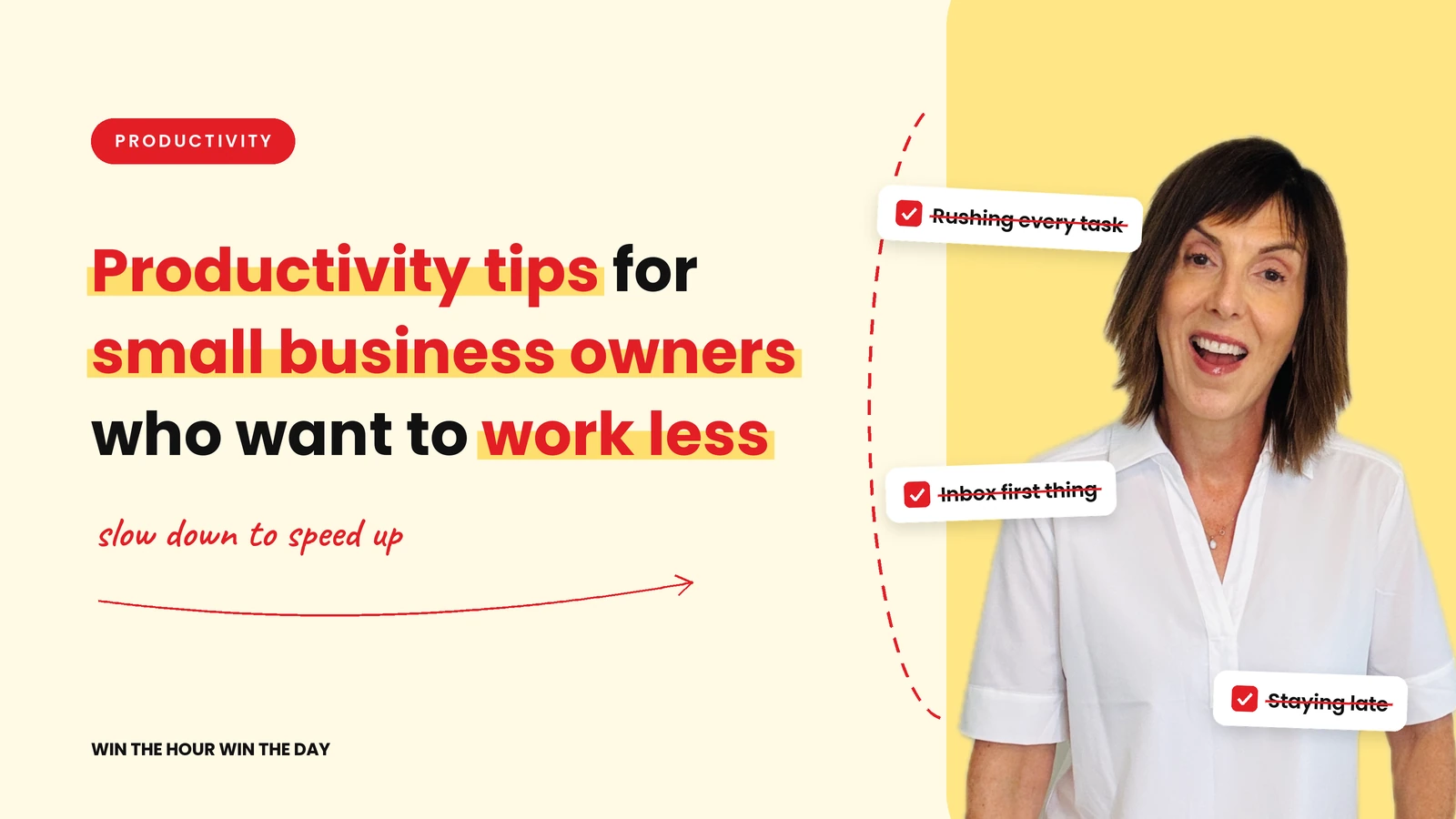
What are the best productivity tips for small business owners who want to work less? Put your own work on your calendar, give your first hour to your most important task, and move every repeat task into a Super Toolkit so a trained virtual assistant can run it without you.
You start the day in your inbox. You bounce from task to task. And the to-do list in your hand only grows, it never gets smaller.
Going faster won't fix that.
I know, because speed was my whole plan for years. These are the productivity tips that changed my days, and the days of the founders we work with.

What are the best productivity tips for small business owners?
The best productivity tips for small business owners fix the setup around your work.
More hours won't do it.
That time doesn't come back when you stay later. It comes back when the work has a clear place to live, outside your head.
Here are the 7 that made the biggest difference for us.
#1 Slow down to speed up
Rushing feels productive, but it costs you time.
I call myself a recovering rushaholic. I talked fast, moved even faster and thought speed was my superpower.
Several times, I tried to walk through a door before I opened it. I ate lunch with my left hand while I answered emails with my right. To me, breaks were for the weak.
My only plan for getting more done was to go faster and stay later. I skimmed over everything…
and I never got any real traction.
I had to slow down to speed up.
Kris Ward
My personality didn't change overnight. The setup around my day did, and the 6 tips below are that setup.
#2 Give your first hour to your most important work
Your brain is freshest first thing, so spend that hour on the work that needs the most focus.
Most founders start the day in their inbox. The plan is to clear it fast and then get to the real work. Instead, the real work gets pushed into the evening, when you have the least left to give.
Every email is a small decision. Open your inbox first and your battery starts draining before your day has even begun.
That's how I finally finished my Win The Hour Win The Day book. I wrote 5 pages first thing every morning, before anything else could get in.
If you feel you have to check email first so nothing blows up, that points to a bigger problem. Your inbox needs someone else running it.
There are more ways to protect your mornings in these 5 time management tips.
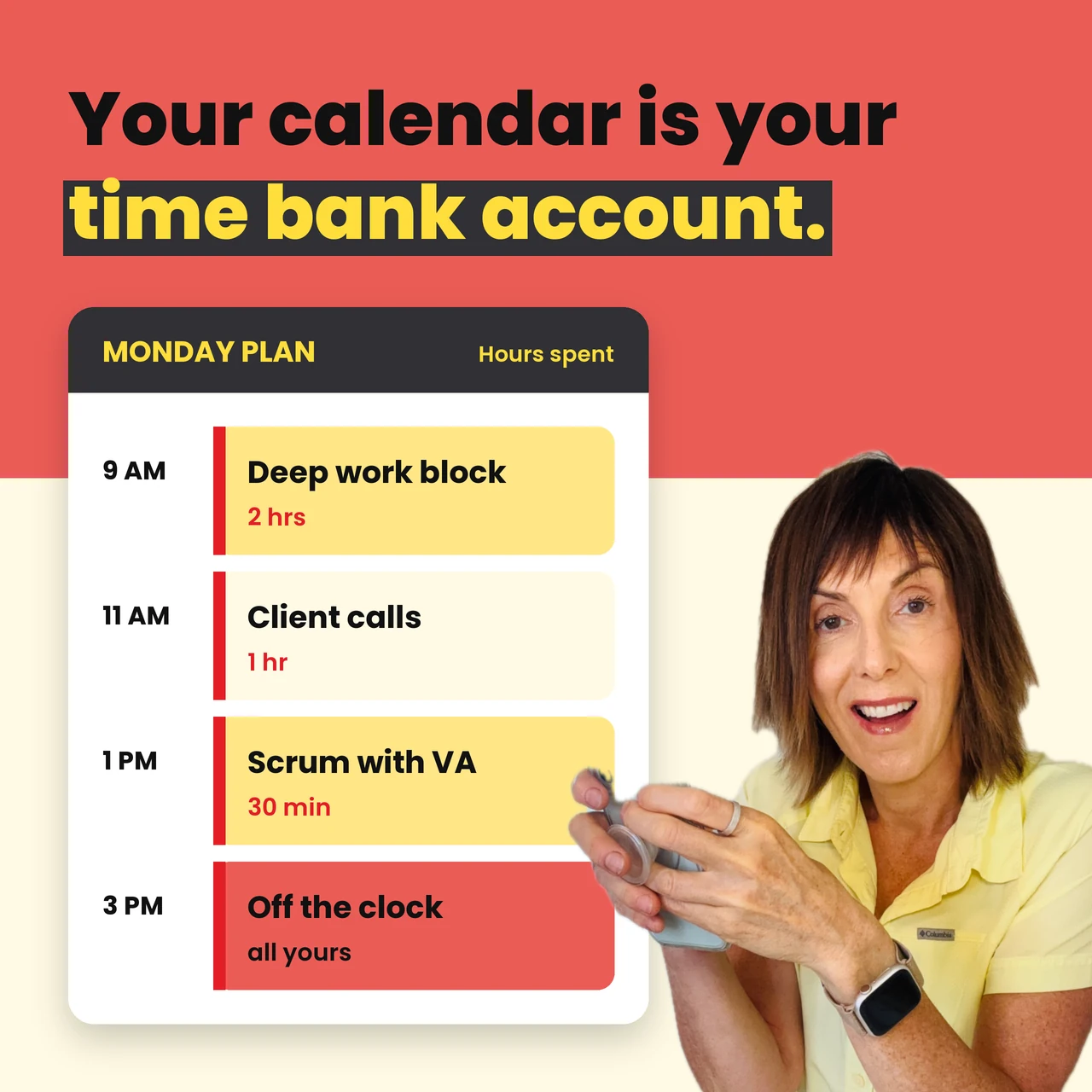
#3 Treat your calendar like a time bank account
Your calendar is a tool, so put your own work on it, too.
Most founders only use their calendar for calls with clients and prospects. Their own work never makes it on there.
We hear it all the time. "I do that every day, so I don't need to put it in my calendar."
Think about your car payment. You'd never leave it out of your budget just because it comes out every month. The money is still gone.
Your time works the same way. You head into the day thinking you have 8 hours. You really have 6, because email and daily tasks were never counted.
A list of percolating emergencies. No time on anything, nothing to show what's urgent, and it only grows.
Your work blocked in 1-hour chunks. You see what fits, how long each job really takes and what to charge for it.
That's the heart of Win The Hour. When work has a block of time, you can measure it. When you can measure it, you can hand it off.
You can't give someone your to-do list and expect them to run with it. You can give them a calendar block and a Super Toolkit.
→Related read, How to Stop Being the Bottleneck in Your Business
#4 Do 1 task at a time
Multitasking is really task switching, and every switch leaves part of your attention behind.
When you jump from task to task, some of your focus stays stuck on the last thing. That's called attention residue. It's why a busy day of bouncing around leaves you so drained.
- ✓You lose time finding your place again.
- ✓You make more mistakes.
- ✓You lose track of how long things really take.
Half-done projects cost you too. Picture a candle business with a shelf full of candles. Some are missing wicks, some are missing scents, and none of them can be sold.
Unfinished work is expensive inventory.
So set a timer, finish 1 thing, and then move on to the next.
#5 Work backwards from the due date
Start with the due date and count back, so you know early if you're off track.
You already do this in real life. Say there's a family birthday party on Saturday at 1 PM. The drive is an hour, getting ready takes an hour, and getting everyone out the door takes a bit more.
So you know to start getting ready at 10 AM. Nobody has to remind you.
At work, most of us skip that math. A new project comes in, we get excited and we dive right in.
- ✓When is the due date?
- ✓When does the client need to review it?
- ✓When does my draft need to be ready?
- ✓How long does this kind of work usually take me?
You may find that a project due in 3 weeks has to start this week.
#6 Put every repeat task in a Super Toolkit
Businesses don't run on memories, so every repeat task needs its steps in 1 place.
A Super Toolkit holds every step and every link for a task in 1 place. Anyone on your team can open it and do the work without asking you where things are.
Many founders push back here. You started a business for freedom, and "systems and processes" sound like a cage.
Old corporate manuals earned that. The people doing the work never wrote them, and they mostly existed to cover liability.
A Super Toolkit grows every time the work gets better.
- ✓You never have to relearn a task.
- ✓Fewer mistakes slip through.
- ✓The results stay the same every time.
- ✓The work can move to someone else.
This is what gets you out of reaction mode and into traction mode.
Super Toolkits
Every step and every link for a task in 1 place, so the work moves without you.
Scrum
A short daily Scrum where your team shares what they're working on and where they're stuck. You answer once, and the answer goes into the Super Toolkit.
→Related read, How to Build a Business That Runs Without You
#7 Bring your virtual assistant into your goals
A virtual assistant saves you the most time when they know your goals and have a setup they can lead in.
Most founders hire someone and then check their work like a teacher grading homework. That keeps every decision sitting on your desk.
Share your goals instead. Tell your VA exactly what you're aiming for, and talk it through in Scrum. When they know the endgame, their work gets more focused.
They can't fix you if you're running around full speed reacting to your to-do list.
Kris Ward
Founder, Win The Hour Win The Day
That's why we set up the work first. Then we find, hire and onboard a full-time virtual assistant we train to lead.
Christine went from crazy hours to 9 days a month. Corey took her first laptop-free vacation. And I went from 16-hour days down to 6.
None of us got faster. We got a better setup.

Not sure where your week is going?
Take the 5 Minute Capacity Check and see what's ready to come off your plate.
TAKE THE 5 MINUTE CAPACITY CHECK
Key Takeaways
- ✓Going faster won't fix it. You have to slow down to speed up.
- ✓Give your first hour to the work that needs the most focus, and check email later.
- ✓Your calendar is your time bank account. Put your own work on it in 1-hour blocks.
- ✓Finish 1 task before you start the next. Unfinished work is expensive inventory.
- ✓Businesses don't run on memories. Put every repeat task in a Super Toolkit.
- ✓A virtual assistant saves you time when they know your goals and have a setup they can lead in.
Frequently asked questions
What are the best productivity tips for small business owners?
Put your own work on your calendar, spend your first hour on your most important task, do 1 task at a time and work backwards from due dates. Then move repeat tasks into Super Toolkits so a trained virtual assistant can run them.
Should I stop using a to-do list?
For planning your day, yes. A to-do list has no time on it, so you can't see what fits or how long things take. Time blocking your calendar shows you both, and it makes the work easier to hand off.
How do I work less without my business slowing down?
Move the work out of your head. When every step and link for a task lives in a Super Toolkit, and a short daily Scrum answers questions fast, the work keeps moving without you.
When should I hire a virtual assistant?
Once your own work is on your calendar and your repeat tasks are written down. Then we find, hire and onboard a full-time virtual assistant we train to lead.