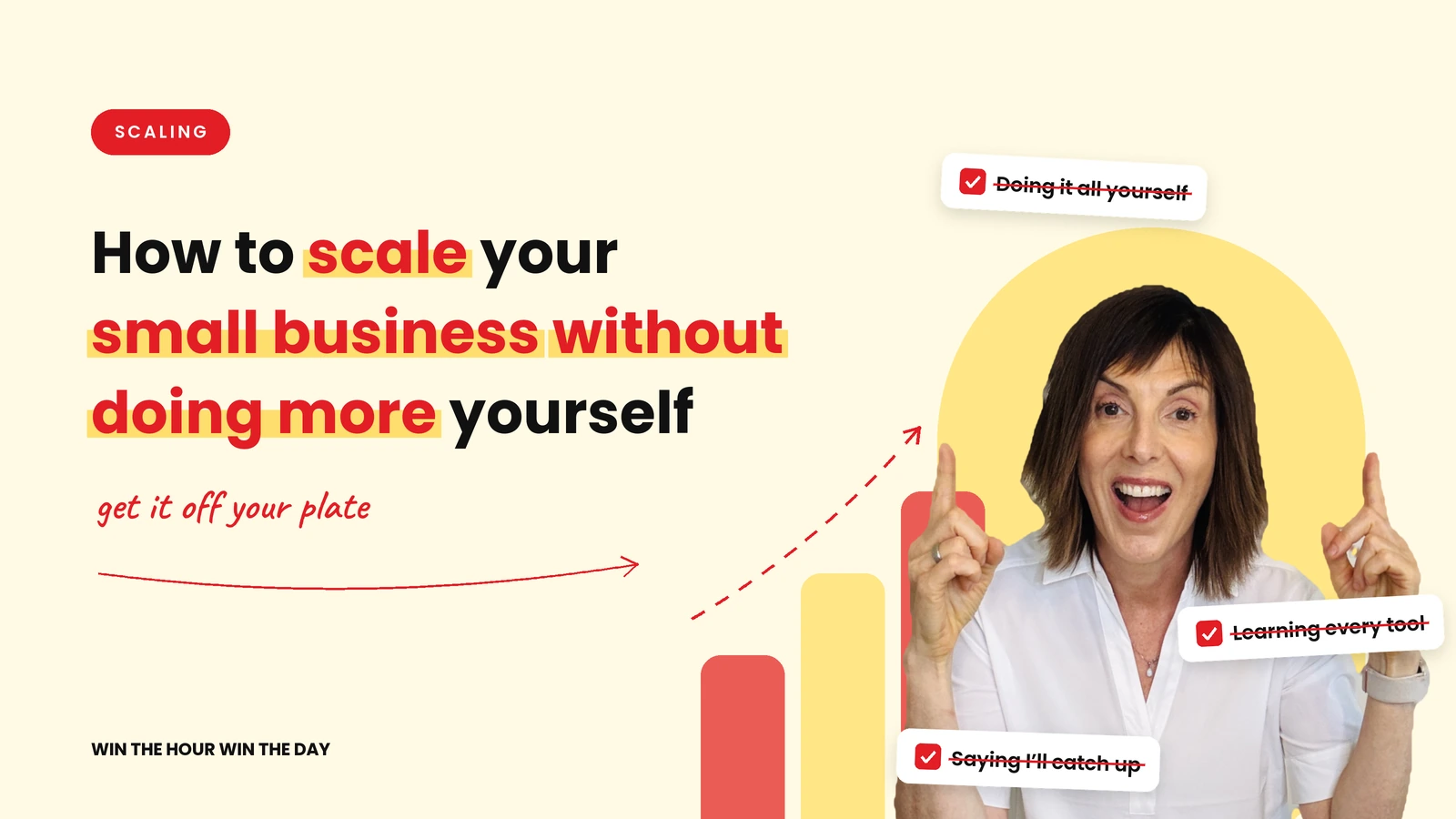
How do you scale your small business without doing more yourself? Get the work that doesn't need you off your plate first, starting with the tasks you repeat every week, and put the steps in a Super Toolkit so a trained virtual assistant can run them.
You've been at this for years and you're good at what you do. Behind the scenes, everything still runs through you.
Once this busy stretch is over. Once this big client wraps up. Once you finally catch up.
10 years in, you're still saying it.
Every founder wants to grow. But growth that needs more of your hours stops the day your hours run out.
Here's how we look at scaling, and how to know what to hand off first.

How to scale your small business without doing more yourself
To scale your small business, grow what comes in without growing the hours you put in.
That only happens when the work stops living in your head.
Most founders try to scale by adding more. More clients, more tools, more late nights.
Tools can make your work faster, but they rarely take work away.
The founders who scale do something else. They get the work that doesn't need them off their plate…
and they do it early.
Here are the 6 steps we take with the founders we work with.
#1 Know the signs you’ve outgrown doing it all
You've outgrown doing it all when your business is busy but your best work keeps waiting.
Most founders never notice the moment. They just feel more and more behind.
- ✓Your big ideas keep getting pushed to next month.
- ✓New leads get ignored whenever client work piles up.
- ✓You're tired in a way a weekend doesn't fix.
- ✓You blame yourself for not being more disciplined.
If 2 or more of those sound like your week, the work has outgrown the setup.
The leads cost the most. You land new business, get busy delivering it and stop following up. Then it all goes quiet, and you start again from zero.
That's feast or famine, and it keeps repeating.
#2 Change the setup instead of reorganizing it
Getting more organized won't scale your business, because you're still the person doing all of it.
When things feel out of hand, most founders turn on themselves. I need to be more disciplined. I need a better system for my notes.
So they reorganize. New folders, new apps, a fresh color-coded list.
It feels like progress for a week. Then the same work lands back on the same desk.
You're a runner stopping every 10 feet to tie your shoes. A tidier desk won't stop that. Getting the work into someone else's hands will.
You are only a good leader if you have the ability to get stuff off your desk.
Kris Ward
#3 Make 2 lists before you hand anything off
Your first hand-offs are hiding in 2 lists, what you do every day and what you'd rather not do at all.
You don't need a big plan to start. You need a pen and 1 honest week.
Try this for 1 week
List 1 is everything you do every day. List 2 is everything you don't like doing. Write each task down as it happens, not from memory on Friday.
Most founders are surprised by how long both lists get. Things get lumped together under "running the business," and a lot of it has nothing to do with the reason clients pay you.
For more ways to spot where your hours go, read these ways to win back time in your business.
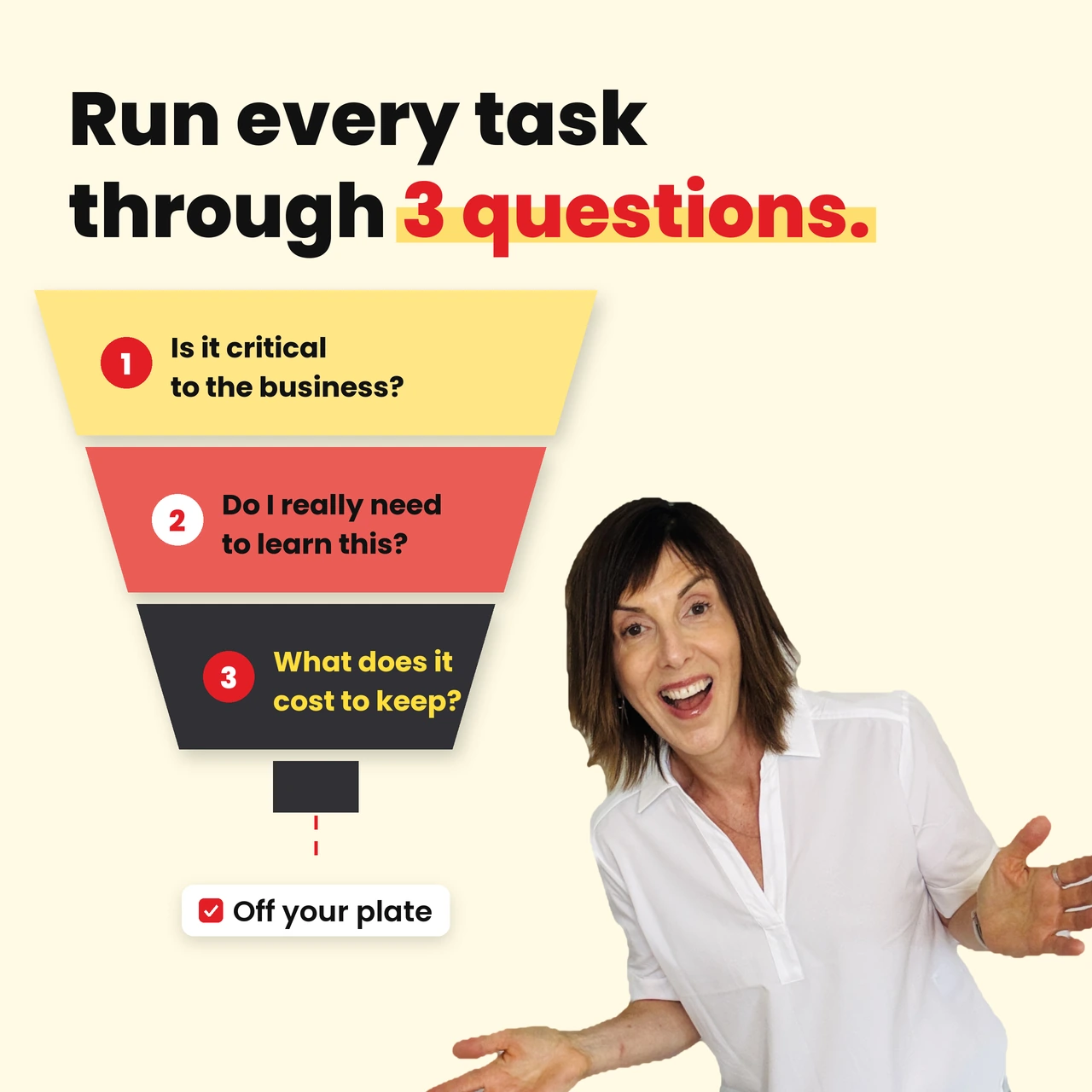
#4 Run every task through 3 questions
Ask 3 questions about each task on your lists, and the answers show you what to hand off first.
Is it critical? If a task is critical to your business, keep it for now. But look closely, because a lot of work sits around the critical part.
Say you're a speaker. The talk is yours. The research for new stages, the onboarding for new clients and the follow-up on social media can all go to someone else.
We worked with a founder who specializes in search engines. He thought his work was too specific to hand off. Then he handed off his prep and research…
and got his time back for the work that brings in income.
Do I really need to learn this? For a long time, I thought I had to learn everything first and then train my team.
What I found was that it was often faster to let them set up the process, while I learned just enough to get by.
That gave me a lot more time and energy for the parts of the business that bring in revenue.
What does it cost to keep? Most founders ask what it costs to hand a task off. The better question is what it costs to keep it.
For every hour you spend on admin, what deals are you missing? Which clients aren't you talking to?
#5 Start with 1 person and grow from there
You don't need a big team to scale, you need 1 person with a setup they can lead in.
Building a team sounds like a big project. So let's change what team means.
Team is a philosophy, not a number. You can have a team of 1.
Kris Ward
Founder, Win The Hour Win The Day
A lean team can run a busy business. Start with a virtual assistant. When the steps for the work are written down, your first team member can train the next person.
Be clear about what you're asking for, too. Founders often ask for a social media manager when they really want someone to write copy, design graphics and run every platform. Those are different skills.
Making your first hire? Start with what to know before hiring a virtual assistant.
→Related read, How to Stop Being the Bottleneck in Your Business
#6 Put the steps in a Super Toolkit before you hand off
A hand-off sticks when every step and every link for the task is in 1 place your team can open.
If the steps only live in your head, every hand-off turns into 20 questions. The answers all come from you…
and so does the work.
A Super Toolkit holds the steps and the links together. Your team opens it and does the work without hunting for you.
Super Toolkits
Every step and every link for a task in 1 place, so a hand-off doesn't come back to you.
Scrum
A short daily Scrum where your team shares what they're working on and where they're stuck. Questions get answered fast, and the work keeps moving.
→Related read, How to Build a Business That Runs Without You
That's why we set up the work first. Then we find, hire and onboard a full-time virtual assistant we train to lead.
Christine went from crazy hours to 9 days a month. I went from 16-hour days down to 6.
We didn't add hours. We took work off our plates.

Not sure what to hand off first?
Take the 5 Minute Capacity Check and see what's ready to come off your plate.
TAKE THE 5 MINUTE CAPACITY CHECK
Key Takeaways
- ✓Scaling means growing what comes in without growing your hours.
- ✓Big ideas on hold, ignored leads, deep tiredness and self-blame are signs you've outgrown doing it all.
- ✓Getting more organized keeps the same setup. Change who does the work.
- ✓Make 2 lists, what you do every day and what you don't like doing.
- ✓Run each task through 3 questions to see what to hand off first.
- ✓Start with 1 person and a Super Toolkit, and grow from there.
Frequently asked questions
How do you scale your small business without working more hours?
Grow what comes in without growing your hours. Get the repeat work that doesn't need you off your plate, put the steps in a Super Toolkit and hand it to a trained virtual assistant.
What should I hand off first?
Start with the tasks you do every day and the tasks you don't like doing. Then ask 3 questions. Is it critical? Do I really need to learn it? What does it cost to keep?
Do I need to know how to do a task before I hand it off?
No. Learn enough to know the outcome you want. A good virtual assistant can set up the process, and the steps go into a Super Toolkit so nobody has to learn it twice.
Do I need a big team to scale my business?
No. Team is a philosophy, not a number. You can start with 1 virtual assistant and a setup they can lead in, then add people as the work grows.
TAKE THE 5 MINUTE CAPACITY CHECK
Hear PJ Dixon share how this "gave me back so much of my time."