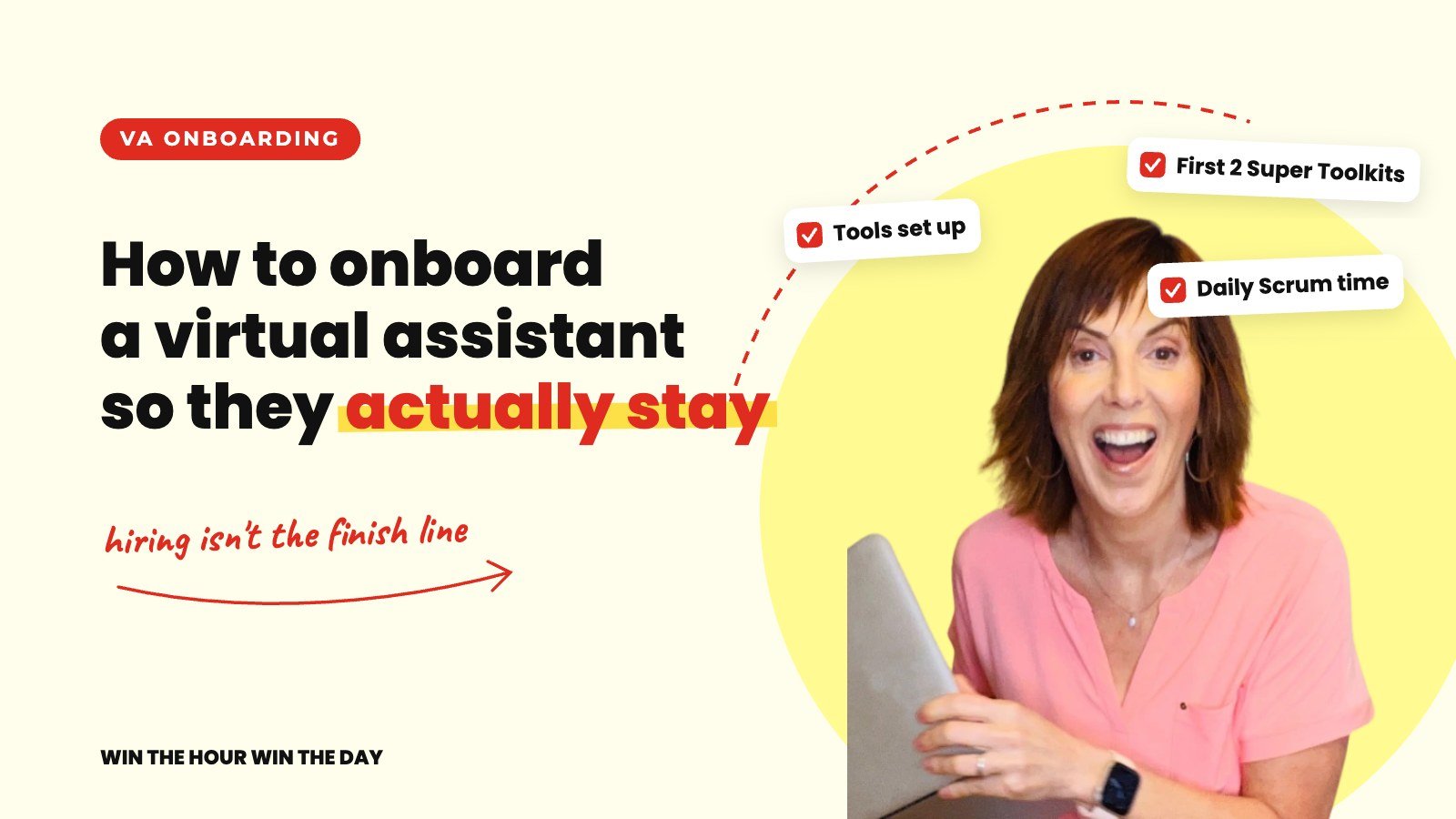
How do you onboard a virtual assistant so they actually stay? To onboard a virtual assistant well…
set up the work before they start. Have their first 2 tasks written down step by step…
with every link inside the steps.
Give them a short daily Scrum…
so their questions have a home. Then hand over ownership 1 piece at a time. That's the whole approach.
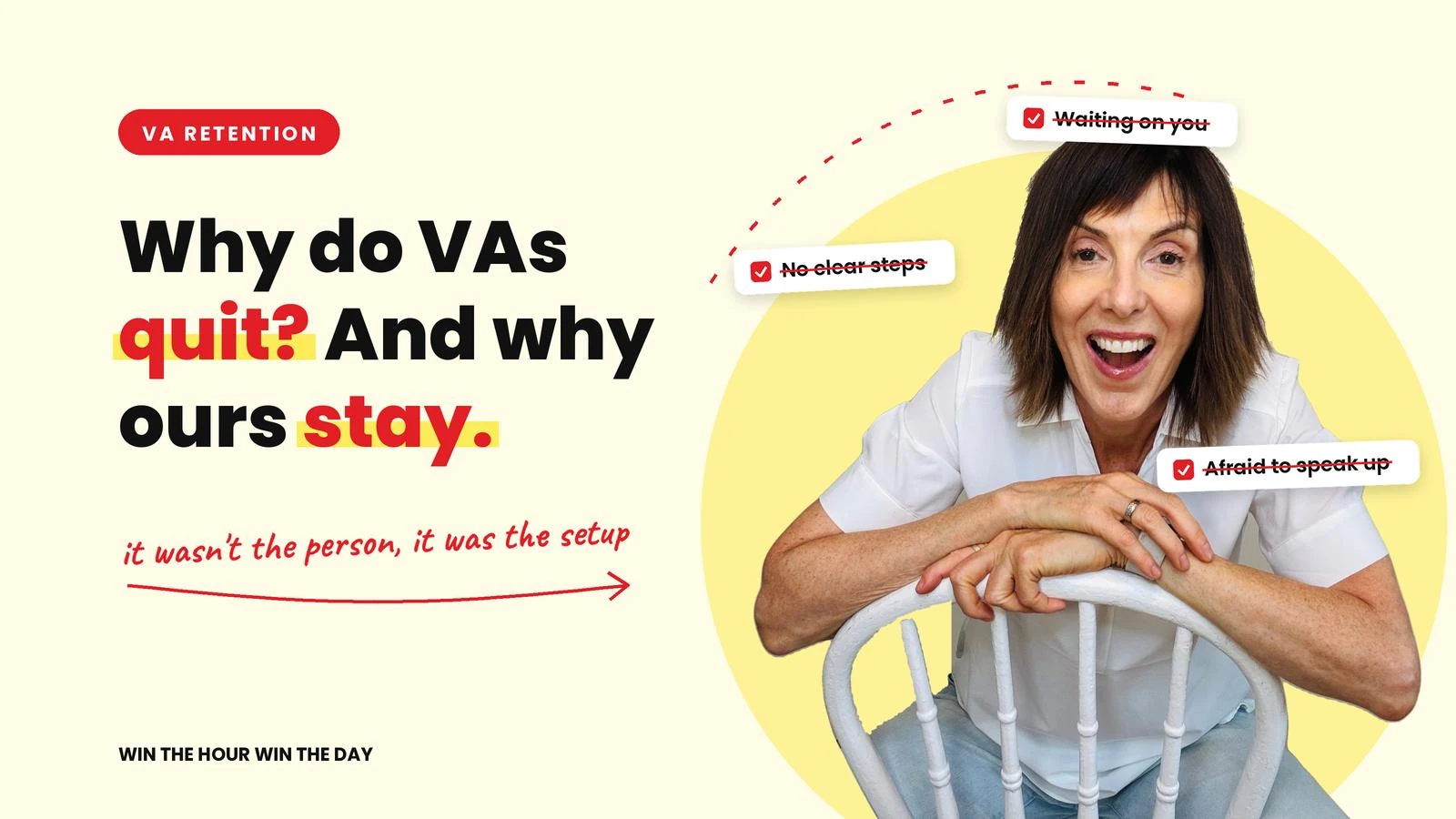
This is why it matters so much. Most VA hires don't fall apart because of the person. They fall apart in the first month…
when there's nothing to step into.
Let me show you how to get those first 30 days right.
#1 Why do so many virtual assistant hires fall apart in the first month?
Because the VA starts before the work is ready for them. It usually goes like this. You finally find someone good, and you're relieved.
You send over a few logins and a quick list…
and you get back to your day. By day 3, the questions start. Where's the file for this client?
Do you want me to send this, or do you? Every answer lives in your head…
so every question comes back to you. Within a few weeks…
you're doing your job and theirs.
It started with relief…
and it ends with you taking the work back. Hiring isn't the finish line. It's the whole game.
#2 What should be ready before my virtual assistant’s first day?
The first 2 tasks they'll own…
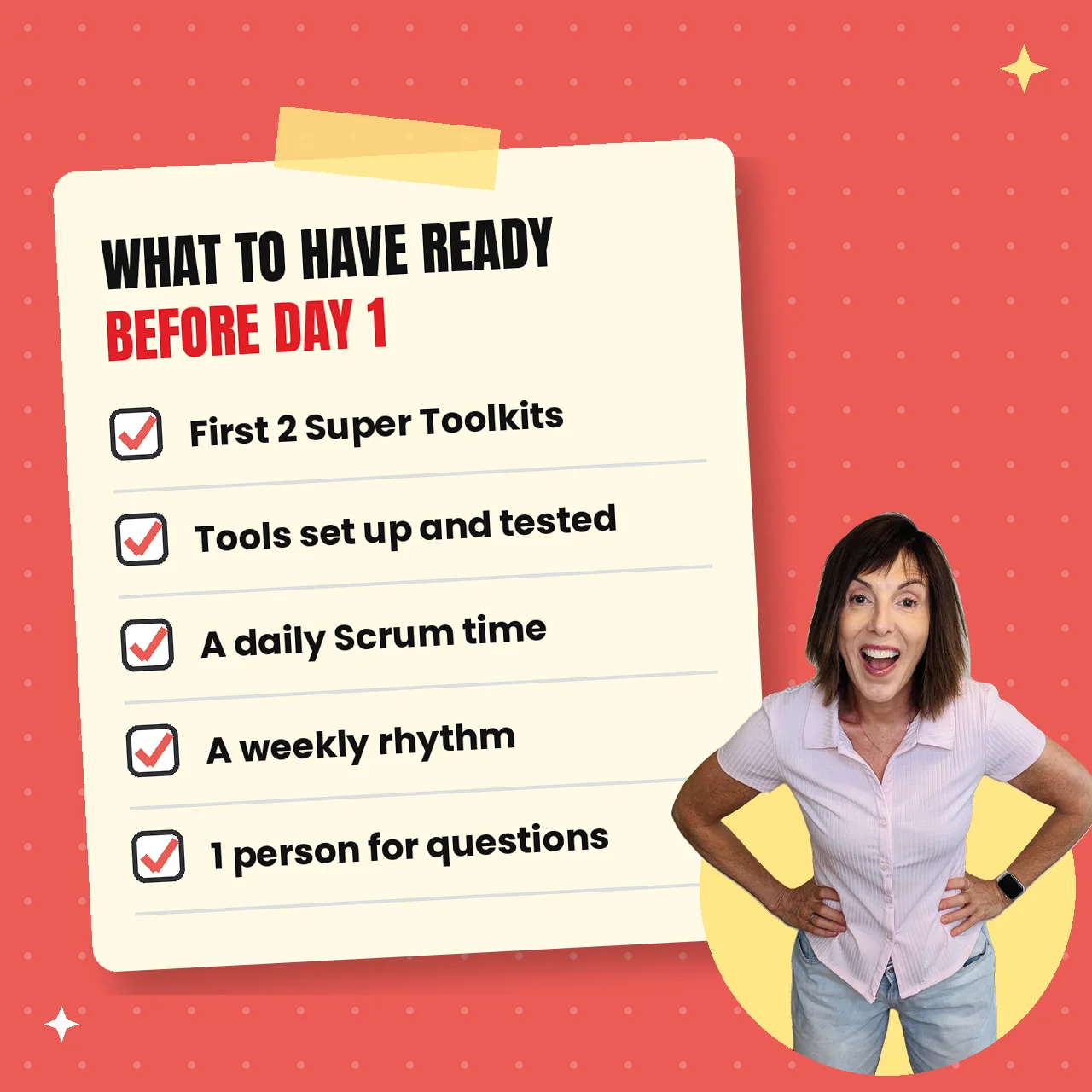
written so they can follow them without you. Here's what to have in place before day 1.
- ✓Their first 2 Super Toolkits.One for each task they'll own first…
with every step written out and every link inside the step. - ✓Access to the tools they need.Email, calendar, project board, shared drive…
set up and tested before they log in. - ✓A daily Scrum time.15 minutes, same time every day…
on both calendars. - ✓Their weekly rhythm.What happens on which day…
so they're never waiting to be told. - ✓1 person to bring questions to.Usually that's you at the start.
You don't need a 40-page manual. You need the first 2 tasks ready to run.
#3 Why do the links need to sit inside the steps?
Because hunting for things is where the time goes. McKinsey Global Institute found…
that people spend nearly 20% of the workweek…
looking for internal information…
or tracking down the person who has it.
For a new VA, everything is new. If the step says "send the welcome email"…
but the template lives somewhere else…
they have to stop and search, and they'll probably ask you.
If the template link sits right inside the step…
they just do it. That's the difference between a guide…
and a guide someone actually uses.
Your VA should never have to hunt and gather.
Kris Ward
Founder, Win The Hour Win The Day

#4 What does the first 30 days look like?
Week by week, ownership grows. This is a sample path. Every VA moves at their own pace.
Week 1
Follows the first 2 Super Toolkits, joins the daily Scrum, writes down every question
Answers once at Scrum, adds each answer to the Super Toolkit
Week 2
Runs the first 2 tasks with fewer questions, suggests fixes to the steps
Reviews instead of doing
Week 3
Takes on task 3, brings you what's done and what's stuck
Makes the calls only you can make
Week 4
Owns the first area of work, plans their week on the calendar
Hands over the next area
It feels slow in week 1…
but you're laying the foundation. Do a little of this every day…
and it won't take this long again.
#5 How do I stop being the answer to every question?
Give the questions a home. A new VA will have questions, and that's normal. What matters is when they come at you.
When questions land all day…
each one pulls you out of your work. So collect them for a short daily Scrum. Your VA shares what they're working on…
and where they're stuck.
You answer once. Then the answer goes into the Super Toolkit…
so nobody has to ask again.
Every question your VA asks…
shows you a step that's missing. Fix the step, and the question disappears.
Kris Ward
Not sure where your setup is leaking?
Take the 5 Minute Capacity Check.
It shows you where your business depends on you most…
before you bring anyone new in.

#6 What kind of feedback works best in the first month?
Clear feedback that names exactly what to repeat. "Great job" feels warm…
but it doesn't tell your VA what to do again.
Praise the behavior, not the outcome.
Now they know exactly what to keep doing.
The same goes for corrections. Say what you need plainly…
while it's still small. Nobody can read your mind.
Making people guess what you're thinking isn't kind. Clear is kind.

#7 How long until my virtual assistant works on their own?
It depends on the VA and on how ready the setup is. When the setup is ready before they start…
ownership begins with the first area of work. From there it grows 1 area at a time…
as each task gets its own Super Toolkit.
The VA who started with your inbox…
can end up running your client follow-through…
and the onboarding of the next person. That's why the first month matters so much. You're building someone who can lead.
At Win The Hour Win The Day…
we find, hire and onboard a full-time VA we train to lead…
and we build the setup with you first. Our clients keep the same VA for years.
Key Takeaways
- ✓Most VA hires fall apart in the first month because there's nothing for the VA to step into, not because of the person.
- ✓Before day 1, have the first 2 tasks written as Super Toolkits with every link inside the steps, plus tool access, a daily Scrum time and a weekly rhythm.
- ✓People spend nearly 20% of the workweek looking for internal information, so links inside the steps cut out the hunting.
- ✓Collect questions for a short daily Scrum, answer once, and add each answer to the Super Toolkit.
- ✓Praise the behavior, not the outcome, and give clear feedback while things are small.
- ✓With the setup ready, ownership starts with the first area of work and grows 1 area at a time.
Bringing on a VA soon? Take the 5 Minute Capacity Check to see what should come off your plate first.
FAQ
How do I onboard a virtual assistant?
Set up the work before they start. Have their first 2 tasks written step by step with every link inside the steps, give them tool access and a short daily Scrum, then hand over ownership 1 area at a time.
What should a virtual assistant onboarding checklist include?
The first 2 Super Toolkits, access to every tool they need, a daily Scrum time on both calendars, a weekly rhythm, and 1 person to bring questions to.
How long does it take to train a virtual assistant?
It depends on the VA and on how ready the setup is. With the setup in place before day 1, ownership starts with the first area of work and grows 1 area at a time after that.
How do I stop my virtual assistant from asking so many questions?
Give the questions a home. Collect them for a short daily Scrum, answer once, and add each answer to the Super Toolkit so nobody has to ask again.
What’s the biggest onboarding mistake with a virtual assistant?
Starting the VA before the work is ready. When every answer lives in your head, every question comes back to you, and the work keeps running through you.
How do I give feedback to a new virtual assistant?
Praise the behavior, not the outcome, so they know exactly what to repeat. Give corrections plainly and early, while they're small.