









Episode Summary
This week’s episode of Win The Hour, Win The Day Podcast interviews, Michael Yap.
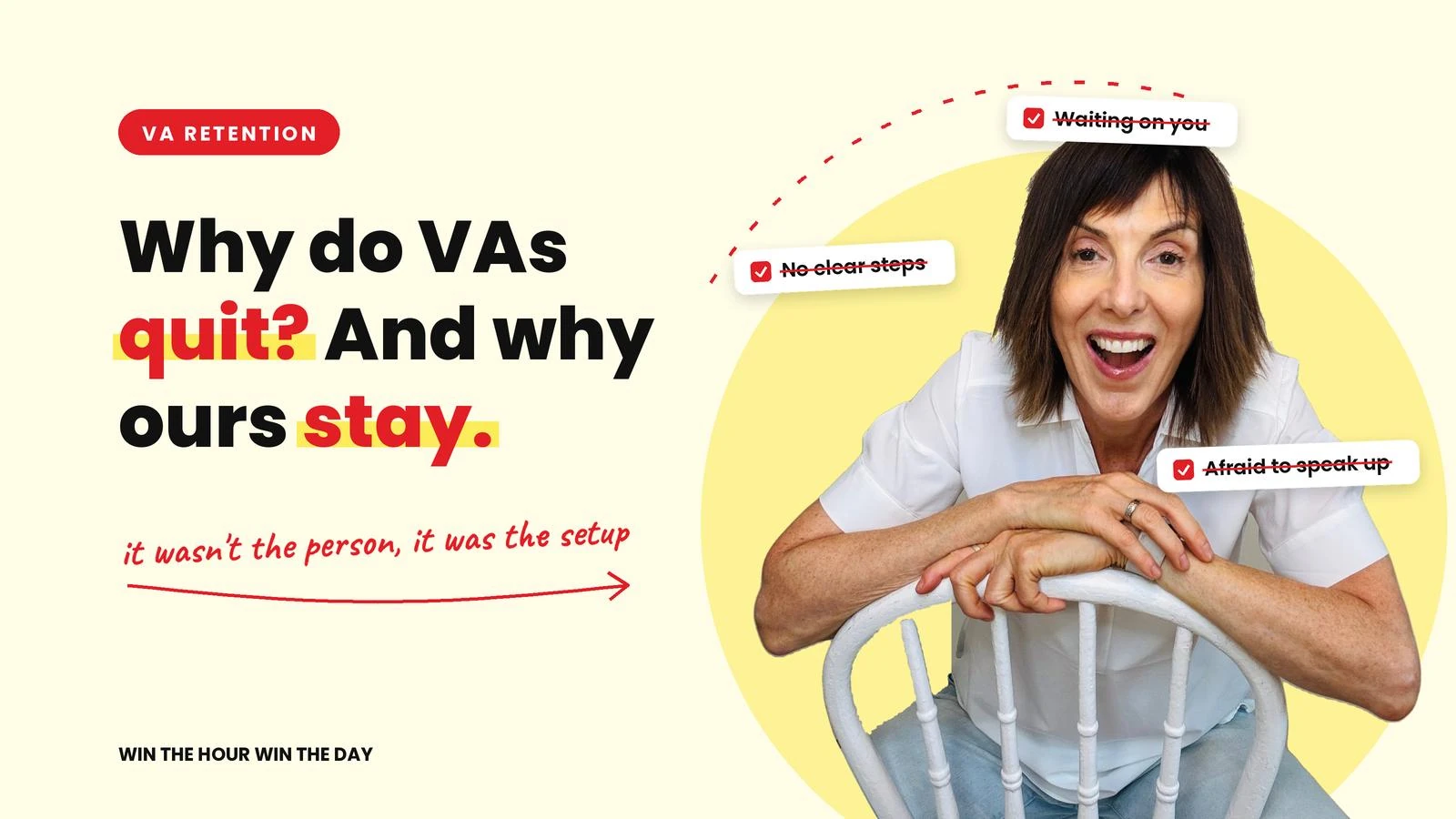
This episode pulls back the curtain on why virtual assistants struggle and what actually makes a remote team work.
On the Win The Hour Win The Day Podcast, Kris Ward sits down with Michael Yap to talk about daily scrums, team culture, and how confidence changes everything.
In this clear and practical talk, you’ll learn:
-Why weekly meetings cause confusion and daily scrums save time.
-How short daily check ins help VAs understand the business faster.
-Why most VAs stop sharing ideas and how to bring that confidence back.
-The real reason business owners burn through multiple virtual assistants.
-How the right systems let VAs think instead of waiting for orders.
-This episode shows what happens when virtual assistants work with you, not for you.
Listen in to learn how better communication and leadership turn a VA into a true team partner.
Win The Hour, Win The Day! www.winthehourwintheday.com
Podcast: Win The Hour, Win The Day Podcast https://podcasts.apple.com/ca/podcast/win-the-hour-win-the-day/id1484859150
Facebook: https://www.facebook.com/winthehourwintheday/
LinkedIn: https://www.linkedin.com/company/win-the-hour-win-the-day-podcast
Win The Hour Win The Day
https://winthehourwintheday.com
Michael Yap Podcast Interview
[00:00:00] Kris Ward: Hey everyone. Welcome to another episode of Win The Hour, Win The Day podcast. And I am your host, Kris Ward, and today we have a special guest in the house. We are taking you behind the scenes. We’re giving you the what’s what and the scoop. What we have is Michael Yap, our Social Media Manager. Now we’re not gonna talk about social media.
We’re going to, we’re gonna talk about something totally different. I found it really interesting when Michael started working with us some of the things that he knows or thought was very different about how we run things here at Win The Hour Win The Day. And it really does lean into what we do when we find, hire and onboard virtual assistants for our clients.
So I thought, let’s have Michael in the show and you can hear it from him. ’cause I found it’s the stuff really interesting. For starters, welcome to the show, Michael.
[00:00:45] Michael Yap: Yeah, I’m glad to be here Kris, and I think it’s about time.
[00:00:49] Kris Ward: Okay. Excellent. Alright, so first things, Michael, when you started with us, oh my gosh, you weren’t here very long.
We just thought we had, it felt like you’d been working with us [00:01:00] forever. ’cause you just, you fit right in. Everything was great and we were just having a fantastic time. Now, a little bit of that, I think is also how often we meet because a lot of people talk to new people on their team or virtual assistants, either through email and they never meet with them, or they meet with them once a week or once in a while.
So I think let’s start with, what was that like for you on how often we met and what did you learn from that?
[00:01:27] Michael Yap: Oh yeah. I think it was a very different experience joining you guys compared to what I’ve been doing for the past few years before, before you it’s, it, I was surprised on how effective it is when it, when we’re communicating almost daily.
Even if it’s just for a few minutes. Yeah. It’s just really it’s just our meetings is just straight to the point. We get things done much more clearly and quickly because there’s no there’s no fluff, there’s no confusion because we meet every day. Like you said, [00:02:00] we’re just we… I’ve just been with you guys four months.
It’s not even a year yet. Oh. And it feels like that I’ve known the business because we met. We met so much, so many times within the months that I spent here with you guys, and then it feels just like I’ve been here for years already. Yeah. And with the systems that you got. Yeah. So it’s easier for me to transition.
[00:02:22] Kris Ward: Yeah, that’s a really good point. So we call them scrums. It’s based on Jeff Sutherland’s book. Double the work and half the time scrum philosophy of getting the ball up the field in rugby and they’re just short huddles or scrums that we have every day. And so what happens is, the example I often given like with you is when you’re here two weeks, in two weeks, you’ve met with us 10 times.
They were just like sometimes 10, 15 minute meetings. But you’re right, the communication is clear. The collaboration is there. Because we’re just having quick little scrums saying, okay, are we that worked out yesterday? Let’s do this. Boom boom. And there’s no misinterpretation that you’re working on something all weekend that I find out next week.
Oh no, that’s not what I meant. And then you [00:03:00] do get to understand the vibe of the people you work with, how the shortcuts, how what we joke about, what we laugh about. It, it just is a whole different game. I think it works, and I know a lot of our clients initially think I don’t have time to meet with my VA every day for 15 minutes.
I’m like, you’ll save so much time. I promise you’ll not give that up.
[00:03:20] Michael Yap: Yeah, I think that’s the hack that most people don’t really understand is because most of the corporate things that people do is that they meet with their team. That’s where what I was used to before, where we just meet like the end of the week or the start of the week, like every Monday, and then we were just left as a VA back then, we were just left to do it all alone, just to try to figure out by ourselves. And then whenever, sometimes there are cases, like when we try to communicate with our bosses or managers, they get sometimes they’re annoyed. That’s why we can, we already had the meeting like last week. Why don’t, you didn’t understand this because, but yeah.
But that’s the [00:04:00] corporate world. So that’s what makes it super different here, working with you guys with the team and Kris is like even we have minimal supervision with Kris or with the other team members because of our daily scrums. We get to know the business more. It’s we’re like part, we’re not like assistants here.
We’re like equal partners because because every day we set up the tone, Kris set up the tone of the meeting. And then it’s just super clear. And also whenever we, you’re, we’re in the scrums with Kris and the whole team you don’t know actually who’s the boss there because everyone has this ownership, like they, they really know what they’re doing. Each member has, has this department and they just took, take ownerships on it. Yeah. So it’s super easy to really work with Kris. Yeah,
[00:04:51] Kris Ward: So what I would say that team is a philosophy, not a number. So you can have one VA and still have the team.[00:05:00]
Philosophy. So yes, I do have a team of four and but to me that’s a big team. You don’t need you definitely don’t always need that for sure. And took me a long time to get here and I, you don’t need that overnight for sure, but you’re right. First of all, I would never, we never use the word boss, right?
I, we are all teammates and what happens is when we’re collaborating every day. When we’re talking about different things, I might have given you something two days ago and then we’re talking about, and when I give you something in Scrum, it’s not, I’m assigning work. It’s we’re coming. We’re working on something new and we’re building something new.
It is not a place where I check to see if you got stuff done like a teacher. That’s not what Scrums are for. So if we’re building some sort of new thing out or a new approach, or I have an idea, I’m asking you guys what do you guys think? And we’re collaborating. We’re building it together. You’re right. I think the biggest compliment I get is when people join our scrums and they say, you know what, if I didn’t know, I wouldn’t know who’s in charge.
[00:05:54] Michael Yap: Yep. Definitely. Yeah. And also with what we’re go going on with the internship with other VAs as [00:06:00] well they are really surprised when they, when we, when all of the team members start talking Oh, like over you, Kris? Yeah. And they sometimes, yeah, we get like their reaction like, oh, they, they’re not used to like other people’s talking talking over to their team leaders or bosses. And yeah, just really fun to watch also with their reactions like how effective we are. And we’re like, man, you’re not like managing us, Kris. We’re, man the reality is we are managing, yeah. We’re telling you what we wanna do, and this is our plan, and then we just collaborate on it.
So yeah, basically…
[00:06:35] Kris Ward: yeah, you’re right. Yeah. It’s I may come in with an idea and you guys may shoot it down. I’m like, okay, what do you think of this? And then you guys all point out no, that doesn’t work. And you’re right, you’re talking about the intern program. So we find, hire and onboard virtual assistants and put them in our leadership program for our clients, the entrepreneurs.
And then there is also an aspect of that where they can do an intern program with us and they come to our scrums and just see how we run it [00:07:00] for a week or two. And you’re right, I, I. I never really understand why they look so shocked. And that’s a good point. You’re looking at them going, oh, they’re not expecting you guys to talk to me like that.
No, that’s not a good idea. It’s oh yeah, you’re right. Okay. And they’re, oh my Lord. Because I am not there to tell you what to do when you are set up effectively. I passionately believe that I am the dumbest person in the room, and I am thrilled with that. I’m thrilled with that. What, I don’t think I’m stupid, but I think if I’m smart and you guys are all smarter than me boy do I have a good setup, right?
And yes, you’re right. They are when we have people through the leadership program doing interns, they’re like what? Like how, why? You’re right. You guys talk over me. You have better ideas and it’s fun. It’s not serious. Business should be fun and we have fun every day ’cause we’re not sitting there in a boring board meeting once a week.
[00:07:53] Michael Yap: Yeah, I agree because we’re not just waiting for instructions, Kris. No. We’re actually creating game plan with you. [00:08:00] Yeah. Which is the fun part. And everyone in the teams just collaborate. They share ideas because they have this confident, like most other VAs won’t have because they’re indoctrinated to have to just keep their heads down and just listen to their managers or their bosses, which is the most differentiate difference between that type of workplace and with the workplace that we are creating here. So the culture is super different.
[00:08:27] Kris Ward: Yeah, and I think you are right. I’ve had people where, they’ll say I told my VA to come up with ideas and I told them to do this and that. And I’m like telling them once and then showing them, you mean it is a total different thing.
’cause I’ve even had jobs where they say, oh my gosh. Yeah, we want you to have ideas and then either I had an idea and maybe they didn’t like it, so then you feel stupid. Or it was better than the bosses and they got insecure and that didn’t work out either. So you do have to take a risk when you’re gonna share an idea.
And so [00:09:00] when people, and you can see when people join the intern program, even their behavior, by the two weeks there, they’re talking over me and we’re having fun and they’re contributing ideas because the whole setup is different. And that does make the difference because otherwise you can tell people, but if you don’t role model the leadership and how you want the communication to be, then nothing changes.
[00:09:24] Michael Yap: Yeah, I agree. Also, I think this is also a huge part with the team leaders as well on how they, I don’t wanna say shut down or something like when a VA or a team…. a team member started to collaborate and then if the idea doesn’t really align with the team leader’s expectation or ideas, yeah, it really depends on how they they talk to the team members. Because it, it’s a huge different when you’re trying to be nice or you’re trying to be direct. Yeah. There’s like a certain point, there’s a [00:10:00] certain line there that the, it’s hard to cross for the team leader on how to deliver that what they call this like the vibe of leadership.
Yeah. Because sometimes they can be off-putting when they try to correct a team member. Yeah. Unlike you, Kris, whenever we have ideas that doesn’t really align with the vision or goal of the business you will do this thing that where you compliment us first. We call you.
Remember, we call it that compliment sandwich. You compliment us first for give, for just giving out the idea for the confidence, and then you will correct us because it doesn’t really align with the goals that we have or we’re trying to figure out. Then you compliment us again. So the takeaway is always the compliment, never the correction.
[00:10:43] Kris Ward: And I wasn’t really aware that I did that, but I do believe in what I was doing. So first of all, just to clarify for your people, the team leaders, we don’t call people bosses. So the entrepreneurs are the team leaders. The VAs are the team members. Okay. So there’s that. And then, yeah, you guys called it a compliment sandwich.
I didn’t know I did that. [00:11:00] Because I do never wanna shoot somebody’s idea down. I wanna say thank you for that idea. It might not be a great fit. And then, here’s what I, why. I never wanna say no. So for example, I do a lot of podcasts and I think someone on the team came up with oh, you should be on this podcast, whatever.
They’re talking about rock climbing. I like rock climbing, that’s fine. And I’m like, yeah, but what’s the, that’s great. I love that you’re thinking about me and I love that you’re thinking about podcasts. I, I love the angle. However, it’s not enough for me just to be on podcasts because I can talk to people.
The whole purpose of a podcast in my time is for it to be a lead generation or for people to be exposed to what we do and talking about me rock climbing is not gonna bring us business. I don’t teach rock climbing, right? Oh, and so what really what I want is for them to learn. Oh, that makes sense. Oh, yeah.
Okay. Got it. So now they understand. I don’t, it’s not important to me to say that’s not a good idea. It’s important for me to change their thinking. Oh yeah, [00:12:00] okay. I don’t, okay, good. So it’s the growth and the growing and the changing and the conversation that I wanna encourage. So saying no doesn’t mean anything to me.
It’s explaining why. And then, yeah, I guess I compliment them again. I didn’t know I did that, but yeah. Because I wanna, again, re I wanna reward the behaviors, not the outcome. Yeah. So thank you for taking a risk, and I want you to take more risks, and I’d rather you have take five risks and maybe four of those ideas aren’t gonna be great, but maybe three of them.
I’m gonna piggyback on your idea and we’re gonna come up with a new idea together. And one of them is gonna be fantastic, but we don’t know if you don’t take risks.
[00:12:39] Michael Yap: Yeah, exactly. So yeah, most of our previous experience also with the corporate thing is a lot of managers tend to be, tend to have this like egoistic thing where they want their ideas to be pushed by the VAs and they just really want to just give the task to them sometimes.
I think that’s [00:13:00] why I said that some of the VAs are indoctrinated to that kind of culture because whenever they do have the ideas and they, some of the managers shut it down, they feel like they’ll, I think they’ll feel stupid. Yeah. And then they just keep their heads down and just go throughout the day.
It is basically, they’re just really surviving and just waiting for a paycheck. Yeah. Yeah. So what’s the difference here is like we have a culture where you, yeah you want us to really have that confidence, want us to think more like a business owner in a way where we take care of the business with you.
We’re just, we’re not just really working for you. We are working with you. Yeah. And yeah, like we mentioned earlier we are like equals here in, in the business, which is a culture shock to some of the the other VAs that went into our internship program as well. So it actually have a lot to do with the team leader as well, not just the VAs, we cannot blame them because it was.
[00:14:00] This is what they’re, they got used to. So I think that what you’re doing with the business owners well, where you teach them how to have a good cult culture, working work culture that rewards people just to be brave enough or to have confidence to even start a conversation with whenever we do the scrums. So that’s another big difference that we have here.
[00:14:20] Kris Ward: Yeah. And I think too, sometimes people will say, oh, it’s a cultural thing. ’cause a lot of the VAs come to the Philippines. And I give a little bit of pushback on that because I think, no, the whole corporate world is very parentified. Like I’ve had jobs where my manager was going through a divorce and it’s oh, he’s cranky for the next three months.
’cause daddy’s in a bad mood and it was a very parentified system. And so it’s not oh these VAs from the Philippines are very different. No, it’s just, that’s how everything is, it’s very parentified. It’s like student, teacher, child, parent, and your manager, your boss and all this other stuff has control over you and can belittle you or whatever.
It’s just, it’s not a good setup. [00:15:00] So to me it is about a team philosophy. Team is philosophy, not a number, and it is about us being equals. And it, and often I’ll too stop if I wanna change a behavior. And I, as I’ll call it a leadership moment. I’ll say, oh, we have a leadership moment here. Something simple hey you know what, sorry.
I actually have an idea. Why did you say, sorry, you have an idea. Let’s do a leadership moment here. Can you say that again without saying sorry. And it’s not the VAs do that. I do that with clients we’re just used to like, oh, excuse me. I have an idea. I don’t like, I don’t wanna interrupt you.
Will you just really minimize what you’re gonna present to me? So you’re right, I’m always looking to extract confidence and have people who are smart, and that’s all the people we bring into our program. They’re smart. But what we want is people to know they’re smart really quickly, not have to work with someone three, four months to figure it out because you have to pull out their personality.
[00:15:53] Michael Yap: I agree. Yeah. And also not just to pin it with the team leaders because [00:16:00] truthfully there are VAs that I think there’s two types of VAs, like the one that just really want to get through the day. Like they just really want to work, get the paycheck, and they don’t really want to grow the business.
They just want to like, they just want to work basically. They just want some tasks. It’s not totally, I think it’s a give and take relationship when you, when a business owner gets a VA as well because they are like I’ve said, there are two types. One that wants to just work and get the paycheck and then there’s those who are want to excel where they have this crazy good ideas that, that they want to build with their team leaders well.
So I think those are the ones that we are trying to to pull in where they are really, maybe sometimes they are, they don’t know how confident they can be or they have great ideas that they just don’t wanna show it so yeah, those are, I think those are the two types of VAs that [00:17:00] are in, in the space right now, especially when we are hiring the, these VAs.
[00:17:05] Kris Ward: Yeah. I think in fairness, they’re good and bad in every industry. Yeah. And I think first of all, we do always hire personality over skillset. We’re looking for people hungry, ambitious, and we do have this 12 point hiring process with a 90% retention rate. And that’s what I’m looking for, is the people that get lit up at the idea of, I wanna, I, oh my gosh, I want a job that’s different and I’m learning and growing, and these are the people that we find and put them into our leadership program and to the ones that you say just want a paycheck and put their head down. To me that’s like over here in, in Canada, I would call them like the accountant types. They just wanna be over there.
Yeah.
Punch in numbers, keep their head down. They’re not, they just leave me alone and let me do my paperwork.
And so that even works if you have the right setting for that. It’s just not our setting. ’cause even no matter how administratively heavy the position may be we’re looking for ideas, we’re looking for personality, we’re looking for people that, as my clients will say, oh my gosh, I feel like I have peers.
Like I, that’s what I feel like I have peers I [00:18:00] have equals for sure. If, I always joke and say, if this was a public funded company, I think you guys would just take over and get rid of me. And they’d be like, we don’t really don’t need her. And she’s a drain on the paycheck. So I think, yeah, to your point, it is really if the setup is there.
Then it is really rewarding for people that wanna have an interesting job and wanna have lots of fun stuff to do.
[00:18:25] Michael Yap: Yeah, I agree. And also on that note as well a lot of pe, a lot of team leaders have this. Putting my shoes in a business owner’s perspective is like a lot of them wants to cut their time short because they like their overwork.
That’s that. I think that’s one of the main reason why they want to hire virtual assistants or VAs in the first place where they initially, in their thought, I believe that they want to cut their ti their time and then just put it all over, put it to the VA’s [00:19:00] capital. Oh, they adapt all the tasks there.
And what they don’t know is if they get someone like who just wants to work and put heads down or who doesn’t want to think they’re actually gonna to have invest more time instead of they hire the VA, but they’re gonna invest more time on them because they have to micromanage them. Yeah. Compared to a VA that’s a thinker or who wants to excel in or who wants to grow with the business, I think those VAs are the ones who’s gonna get the business owners more time to themselves because they can just, when the systems are in place.
Like what we have here with the STKs where a good VA will just run through the STKs and everything is gonna be polished. What? Whatever happens. Yeah. Because the steps are there, they just have to follow. And then when they have ideas, we’re open to ideas. I think those kinds of VAs are the ones who’s gonna liberate the business owners and give them more time back.
[00:19:56] Kris Ward: Yeah. And a couple of things you brought up, which are really important. So everyone calls ’em [00:20:00] STKs, our signature super toolkits that we created. They’re very different than SOPs. SOPs take a long time to make. They’re clunky, they’re outdated quickly, and our signature super toolkits.
It just takes moments to make and they’re always evolving and they’re really a dynamic breathing document that save us all a lot of time and allow everything to be consistent. And I think to your other point is people listening are probably going of course I want that kind of VA, I want someone that cares and is interested in what, like why are we even talking about that other kind of VA.
Why would we want somebody that just puts her head down to do the paperwork? And that’s the thing is how do you know which one that is. Yeah. It’s not something you do in between the other things you’re doing. So if you’re a marketing coach and you think, okay, great, you know what Michael says makes sense.
I wanna really dynamic, interested, passionate VA. All right, by the time I finish all the stuff I have to do today, I’ll start looking for that VA. It’s kinda like I had a client who was a lawyer. And he is a lawyer that dealt with contracts with the biggest banks in the world. And he’s oh man, Kris, I can’t believe I [00:21:00] all this school and I don’t I just don’t have the right VAs and I can’t figure it out.
I’m like ’cause I don’t practice law in between what I do, so why do you think you can go do what I do? In between you practicing. Like hiring is a whole thing on itself and I’ve been working on it for a long time. The onboarding process, the leadership program. So yeah. How do we get these dynamic VAs?
You don’t run around when you’re swamped, overwhelmed and then try to do something you’ve never done before. And then you get them in there and it’s, most of my clients will say a lot of them burn through four or five VAs before okay, maybe it’s me ’cause this isn’t working out.
[00:21:38] Michael Yap: Yeah, exactly. I think they have this, like I know in, in the VA space, a lot of business owners are transitioning towards just getting a virtual assistant number one.
It’s much more affordable than hiring the same people in, in, in your respective country. Because for example, here in the Philippines the amount of [00:22:00] of pay that you give us is actually in in, or in a, it might be like a minimum income in your country, but in our country it’s gonna be in the middle to high already.
Yeah. So not, yeah. Not just that. The, a business owner is saving a lot of cost in their overhead, but they’re actually helping a lot of VAs as well in some of the countries here, especially like here in the Philippines. Also on that note, I think a lot of business owners are, whenever they hear stuff about VA, they get hyper excited. Super excited. Like they want to jump into the first VA they find Oh yeah. And then they forget. Yeah. They forget to screen them because it’ll take time for them to know what kind of VAs like you mentioned, because they won’t know, because a lot of these VAs will be good in paper. They will be good in, in their resume.
They will be good in the portfolio, but their character is super important because you won’t know until you work with them for a certain time. Yeah. Because in the interview [00:23:00] they might. They might say the right answers because some of the, some of these, some of the VAs already gone to a bunch of interviews and they know how to answer interviews, but once they’re in, in, in the workspace already some of them might be good, but not compatible with certain business owners.
Yeah, that’s why it’s super important that we’re building culture and finding people who really match the business goals and ideas with these business owners.
[00:23:27] Kris Ward: Yeah, I agree with you and you bring up a really good point, which I’m really glad to hear from you because I never wanted to sound like I’ve had people ask me, and I did too.
The first time I heard about VAs I’m like, oh my gosh, I don’t wanna be taking advantage of somebody. It’s affordable for me. Great. You’re paying somebody five, six US dollars an hour. And that’s very helpful to me. But not if it costs you. And it’s no, I hear from a lot of people, it’s that made you the breadwinner in your family at that pay rate.
And and people quietly ask me sometimes on the side like are you undercutting them? Is that right? And it’s [00:24:00] no, we do not. Sometimes the VA agencies do. That’s a whole different thing. We’re not a VA agency. That’s really great to hear from you because it is, it’s a win-win. It makes it more affordable for us.
And I got help in, when my business was in the newer stages, I would’ve never been able to afford had I not had this opportunity to go work with somebody overseas and then it’s a win for you all because it’s a higher rate of pay and you got this office set up at home. ’cause from what I understand too, it’s not great to travel there.
Like it’s very hectic. Everything’s far away. The roads can be somewhat dangerous depending where you’re going. The money. It saves you from having a home office and the other risk factors. It really is very desirable for you as well.
[00:24:41] Michael Yap: Yeah, exactly. That’s why I’m here in the Philippines also, there’s an influx of a lot of people, it becomes like a heroic thing when you’re a virtual assistant here because like they’ve seen the lifestyle. Like people are, oh, I’ve seen these people are traveling. They’re working while they’re traveling because you can just have to bring the [00:25:00] laptop and you have a good internet where you’re going.
Then you can work everywhere on your own time. There are stuff like that here in the Philippines where…
[00:25:08] Kris Ward: oh, you’re living the life. I see. Okay.
[00:25:11] Michael Yap: Yeah. But they don’t know the struggles also on finding the right. Yeah team leaders because it’s, I think it’s becoming a saturated thing.
That’s why it’s super important to have someone who screens them already for you. Yeah. And yeah, putting myself in a business owner’s shoes, like we, we have this, like you said the 12 point hiring process where we’ve already screened this this pool of virtual assistants. Like I’ve said, it’s saturated.
There is a lot of VAs here and a lot of business owners will make a lot of mistakes. That’s why you mentioned some of the people that you partner with or your our clients, they’ve burned to a lot of VAs because they don’t know exactly what they’re doing or they’re not just getting the right pair or pairing with the VAs to them.
[00:26:00] I think another thing that we are doing here is we have the pool of, we already screened them and we have the pool of VAs. We can easily match their car because when you’re hired not really looking like on resumes or yeah, you look at portfolio just to see what they’re working on, but you rely on characteristics and how they… their work ethics. I remember when I first joined in just the, am I allowed to say that? The first screening part or
[00:26:29] Kris Ward: yeah. The process. Yeah.
[00:26:31] Michael Yap: Yeah. Yep. Kris has this process where she will give us a quick task on just to see how Yeah. How efficient we work. I’m not gonna tell because we might have some VAs Yeah.
And I don’t want to know. But yeah, those are like a secret task that Kris has for the VAs, which is I think on the other end now I see it it’s a fun way to know whether a certain VA is like very efficient on working, even if it’s just our if they know it’s a [00:27:00] super minute task, but it’s super important.
[00:27:01] Kris Ward: It’s a simple task. Yeah. I’m not looking for free work. It should take you 10 minutes to do it, but I am looking to see how quickly you do it, how you communicate to me what, how you speak. Like when you reply to me, is it clear, concise information? There’s, and there’s other things I’m looking for.
And you’re right, I’m not gonna tell people. So the VA’s, you have to do the test like everybody else, but it’s just a quick way to get an idea of how you follow instructions and how you understand requests. And so yeah, it’s, it should take you 10 minutes, but I get a lot of information out of that, and it is very helpful in the hiring process.
[00:27:37] Michael Yap: Yeah, definitely. Yeah. Oh my gosh. Aside from that, yeah, we, the, with the characteristic, you can actually, it’s on the side now that with Kris because I’m a direct team member of Kris we can since we’ve, we’re in the daily scrums, we have some of the team members that who handles the who helps handles the client and the VA process where they’re matching it [00:28:00] because we have all of this information, useful information for the business owners that we can match them to a certain type of VAs. Yeah. Yeah. That will cut the process where they have to figure out if it’s a perfect fit for them. So I think that’s another advantage that we have here.
[00:28:14] Kris Ward: Yeah, we do put a lot into that. Oh my gosh. I could talk to you all day, Michael. Okay. This was fantastic. Thank you for sharing. We love hearing. It, and it’s some of, like I said, some of that information coming from you is really helpful. So it’s not just us saying no, it’s a good fit for them too.
So I’m glad you know how we feel. We’re thrilled to have you on our team, for sure. Okay, everyone else share this episode with a business buddy. There’s lots of content here. Don’t have them banging around by themselves. Make sure you share this, and we will look forward to seeing you in the next episode. Thanks again, Michael.
[00:28:44] Michael Yap: You’re welcome. Thank you guys.